
Serrated, Straight or Julienne Peeler: Choose the Right Blade
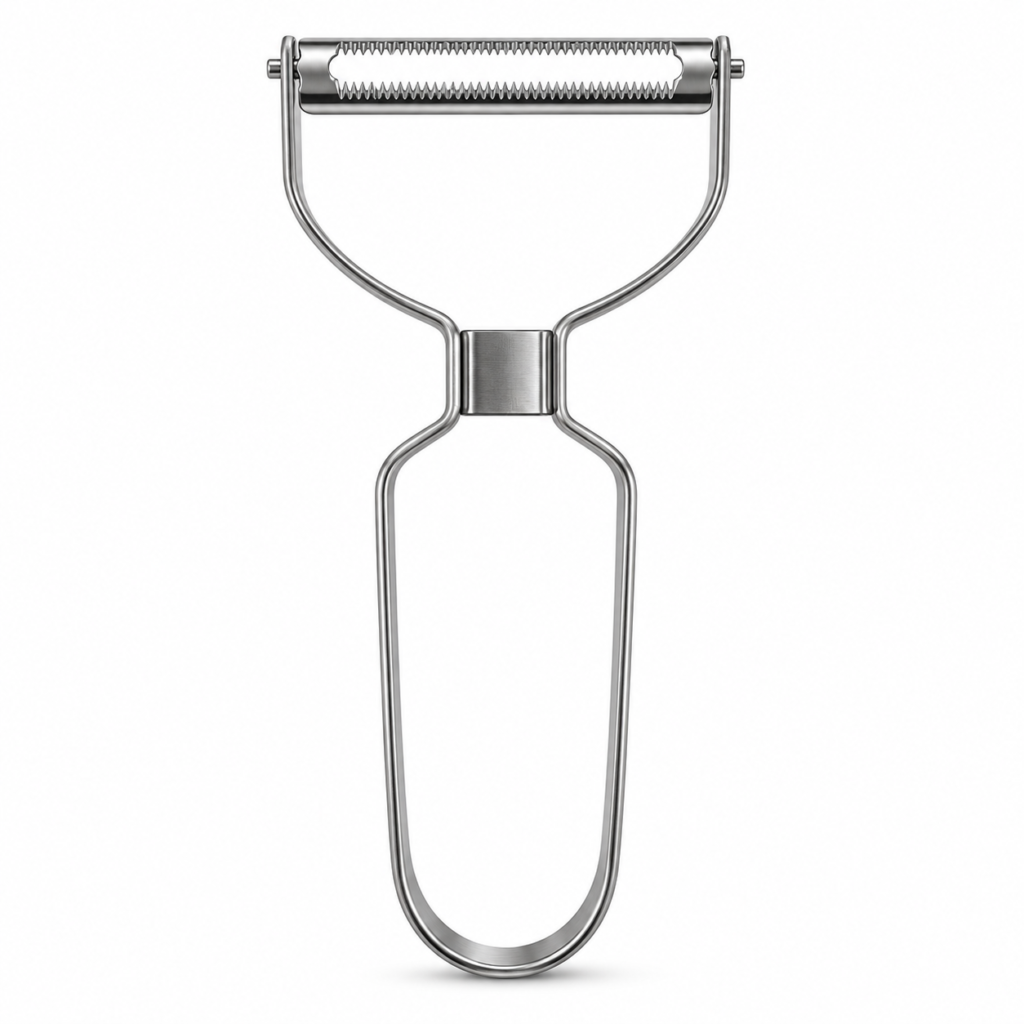
Choose a peeler by its blade and intended cut, not just the shape of its handle. A straight peeler, a serrated peeler and a julienne cutter can look similar from a distance while producing different results. A Y-shaped handle describes the frame; it does not tell you which blade is fitted.
The three blade types
A straight blade is the familiar general-purpose peeling style. A serrated blade has a toothed cutting edge and is commonly intended for gripping the skin of softer produce. A julienne blade is designed to cut narrow strips rather than simply remove a sheet of peel.
OXO’s explanation of its peeler range distinguishes these functions, including serrated blades for delicate-skinned produce and julienne blades for fine strips. These are useful category distinctions, not proof that every tool with visible teeth is a julienne cutter.
Look closely at the listing photograph
Zoom in on the cutting head. Read the named blade type and compare it with the description. If the title says ‘julienne’ but the text only describes peeling, ask the seller to clarify the expected cut. The words ‘multifunction’ or ‘3-in-1’ are not a substitute for a clear explanation of each actual function.
The HandyDost Y-Shaped Vegetable Peeler is listed with a serrated blade. It should not be advertised as a spiralizer or a julienne cutter simply because the edge has teeth. Its silver-coloured finish also does not establish a particular metal grade or dishwasher rating.
Match the blade to the meal you prepare
| What you want | What to look for |
|---|---|
| Remove peel for routine vegetable preparation | A blade specified for your usual produce. |
| Grip delicate fruit or tomato skin | A suitable serrated peeler, with controlled handling. |
| Make narrow matchstick-like strips | A tool explicitly described as a julienne cutter. |
| Make long spiral noodles | A spiralizer designed for that result. |
Keep the ingredient’s firmness in mind. A blade category does not make very soft, overripe produce easier to hold, and no peeler should be forced through hard or frozen food outside its instructions.
Frame and grip still matter
Once the blade type is right, consider how the handle fits your hand and whether the head has room to move over the ingredient. A broad Y frame and a narrow straight handle are different handling choices. Avoid declaring one universally faster or safer without considering the user and task.
Check storage and cleaning access too. A small head with food trapped around it is not convenient if you cannot rinse it properly. Keep the blade visible during washing and store it where someone will not reach into it unexpectedly.
Buy one useful tool before a large set
List your most frequent preparation jobs. If you mainly remove potato and carrot skins, start with a suitable peeling tool. If you regularly want strips for salads, a dedicated strip cutter may be worth considering. Do not buy three near-identical tools because the set looks complete.
For practical technique, read how to use a Y-peeler, peeling tomatoes carefully and ribbons versus strips. More comparisons are in the HandyDost guide library.