
What Can Go Through a Marinade Injector? Check Texture Before Filling
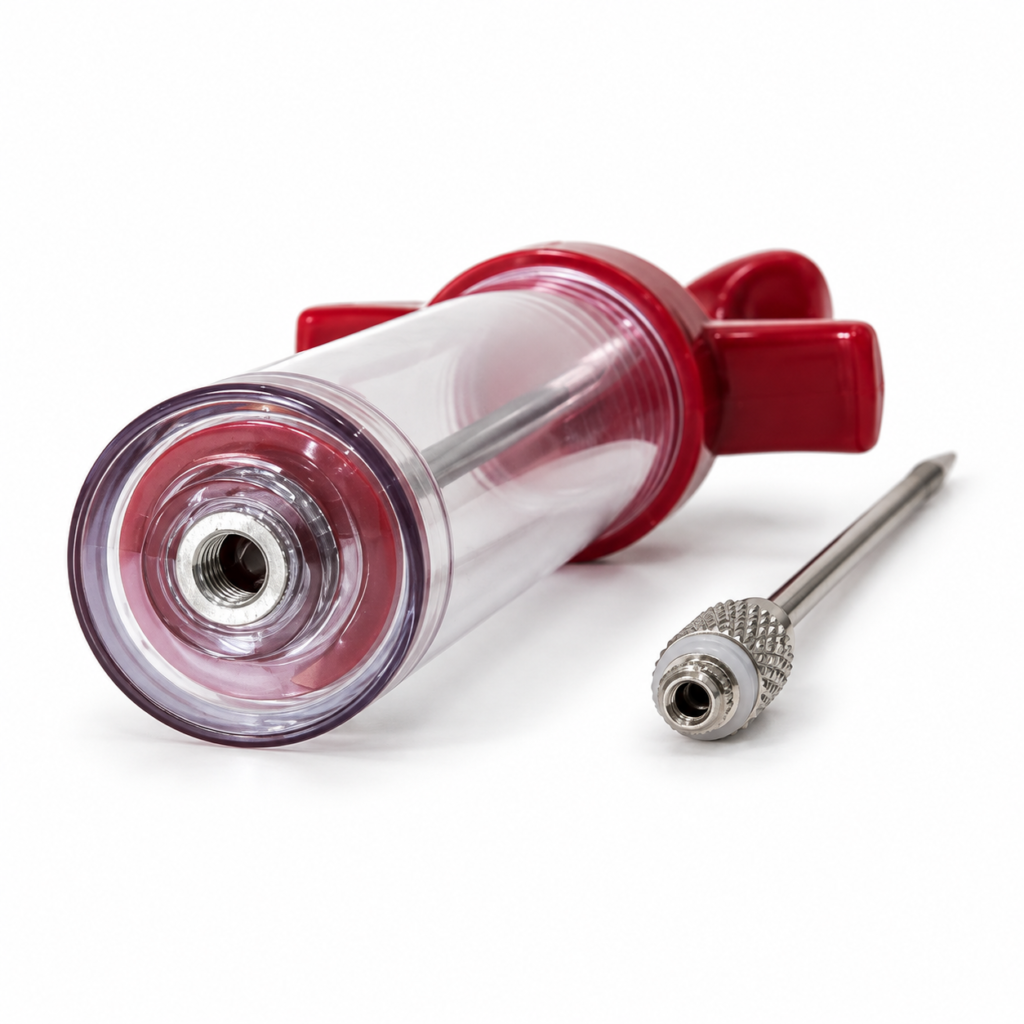
A marinade that spreads well over chicken may still be unsuitable for a narrow injector needle. Before filling the barrel, check the liquid’s texture and the tool’s instructions. The ability to draw something into the barrel does not prove that it will pass through the needle without excessive pressure.
Use the injector’s actual limits
The HandyDost 30 ml marinade injector is described for smooth liquid seasoning without seeds, herb pieces or other particles that could block its needle. It has a detachable needle and marked barrel, but the listing does not specify a validated maximum viscosity or compatibility with every sauce.
A different injector with wider openings or several needle types may have different instructions. Do not transfer those capabilities to a single-needle model from a photograph.
Separate flavour ingredients from their physical form
| What you see | Decision before filling |
|---|---|
| A smooth liquid permitted by the recipe and tool | Check assembly and use controlled pressure |
| Seeds, chilli flakes or herb fragments | Keep them out of this narrow-needle preparation |
| A thick paste or chunky yogurt mixture | Use the recipe’s surface-coating method unless the injector explicitly permits it |
| An unknown bottled sauce | Read ingredients, consistency and preparation directions first |
Do not assume that blending a paste makes it suitable. Nor should you dilute a carefully balanced marinade arbitrarily simply to force it through the tool. Choose a recipe designed for the intended application.
Prepare a small clean working portion
Keep the main food-ingredient containers separate from the injector once it touches raw meat. Set out a working bowl, assemble the tool securely and use a stable preparation surface. Check that parts are intact and that the needle is connected according to the instructions.
Where the chosen liquid needs straining, use suitable clean food equipment and a recipe that permits that preparation. Inspect the result before filling. Straining removes particles; it does not make contaminated liquid safe.
Stop at resistance
If the plunger becomes difficult to move, stop and remove the tool safely from the food before investigating. Do not point the needle toward yourself, press harder with both hands or use the sharp tip as a scraper. Never enlarge a needle opening with an improvised sharp object.
Follow the tool’s disassembly and cleaning directions. A persistent blockage or damaged component is not a reason to continue injecting under pressure.
Keep temperature and raw-food handling separate
Injection is a seasoning method, not a food-safety treatment. USDA’s guidance on soaking and handling meat stresses refrigeration and preventing cross-contamination. An acidic or salty liquid does not remove the need for proper handling and cooking.
Reserve any clean serving sauce before raw-meat contact. Do not return leftover working marinade to an untouched bottle or serve it as an uncooked dip.
Choose surface seasoning when it fits better
If your favourite preparation contains a thick mixture of herbs and spices, it may be better applied on the outside using the recipe’s method. Owning an injector does not mean every marinade has to pass through it.
Read the injector-use guide, blockage troubleshooting and seasoning-method differences. More guides are in the HandyDost blog.
AI-assisted guidance based on published tool information; no recipe viscosity or flavour-performance test is claimed.